

City of Santa Cruz
 “Through measures already implemented, the City of Santa Cruz generates energy from renewable sources that do not contribute to global warming through the emission of greenhouse gases equivalent to 33% of energy used by the City; combined with 13% renewable energy purchased from PG&E, this jumps to over 40%. As more measures are implemented, the City of Santa Cruz will become less dependent on energy sources that cause environmental degradation.” -City of Santa Cruz Website
About Santa Cruz
- Incorporated: March 31, 1866
- Population: 56,124 (2008)
- Location: 72 miles south of San Francisco on the northern edge of Monterey Bay in Santa Cruz County
- Elevation: 36 feet
- Area: 15.6 square miles
Climate Action Activities
- ICLEI member
- U.S. Conference of Mayor Climate Protection Agreement Signatory
- Tree City USA
- Resilient Communities for America Agreement Signatory
- Established the Climate Action Program, 2007
- Established Climate Change Compact (partnership with UC Santa Cruz and Santa Cruz County), 2007
- Completed Greenhouse Gas Emissions Inventory, February 2010
- Completed Climate Action Plan, September 2010
- Adopted “Green Building Regulations“, November 2005
- Adopted “Residential Green Building Program“, August 2008
- Established “Clean Ocean Business” program
- Promote local businesses certified through Monterey Bay Area Green Business Program
Climate Action Resources
- Climate Action Program webpage
- Greenhouse Gas Inventories and Reduction Projects
- Climate Action Plan
- City of Santa Cruz Environmental Programs
- City of Santa Cruz Green Building Program
- “Santa Cruz Fights Global Warming” (list of the City’s key initiatives
- Changes to City of Santa Cruz Environmentally Acceptable Food Packaging and Products Ordinance
Awards
Silver Beacon Award (2019)
Agency Energy Savings
- Gold Level, 18% (2017)
- Silver Level, 9% (2014)
Agency Natural Gas Savings
- Silver Level, 7% (2019)
Agency Greenhouse Gas Reductions
- Gold Level, 15% (2015)
Community Greenhouse Gas Reductions
- Platinum Level, 23% (2017)
Sustainability Best Practices
- Platinum Level (2015)
- Silver Level (2014)
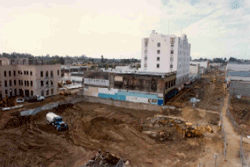 downtown area of Santa Cruz was
transformed from the City’s commercial core to a series of
destroyed and severely damaged buildings.
downtown area of Santa Cruz was
transformed from the City’s commercial core to a series of
destroyed and severely damaged buildings.


