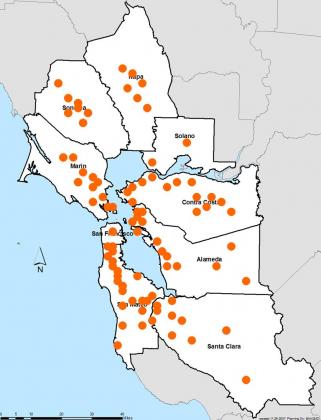
See what cities and counties in the San Francisco Bay Area are
doing to reduce greenhouse gas emissions and adapt to the impacts
of climate change.

Have a best practice you would like to share? Bay Area local
governments are invited to send in their climate actions. Let us
know what, how, and why your climate action worked!
See what cities and counties in the San Francisco Bay Area are
doing to reduce greenhouse gas emissions and adapt to the impacts
of climate change.
The City of Richmond used innovative methods to involve a diverse
cross section of residents in updating its General Plan. The
resulting plan is one of the first in the nation to include an
element that addresses the link between public health and the
built environment.
Air quality in the Bay Area has improved significantly in recent
years due to tight regulation of emissions from all sources,
including industrial facilities and motor vehicles. Smoggy days
have declined substantially over the past 40 years. Despite this
progress, the Bay Area continues to exceed state and/or national
standards for ozone (smog) and particulate matter (PM) on a
limited number of days each year.
With about 27 million metric tons of GHGs a year coming from cars
and light trucks in the Bay Area, increasing the public’s
willingness to take transit, instead of driving, is a key
component of meeting climate protection goals.
Estimated to contribute $11 billion to the local economy, the
Napa Valley wine industry is both the economic engine of Napa
County and one of the County government’s chief allies in climate
protection.
Sonoma County’s nine cities and multiple county agencies have
been engaged in local climate protection efforts for more than
ten years. In 2002, Sonoma became the first county to have all
its jurisdictions conduct greenhouse gas (GHG) emissions
inventories. In 2005, all ten local jurisdictions adopted a joint
target of reducing GHG emissions to 25% below 1990 levels by
2015. In 2009 Sonoma took another pioneering step by establishing
the Regional Climate Protection Authority (RCPA).
Local efforts to reduce energy dependence and slow the threat of
global warming have the potential to create significant business
opportunities. But as the emerging “green economy” grows in
Oakland and throughout the East Bay, where can business leaders
turn for skilled green collar labor? Enter the Oakland Green Jobs
Corps, a program to meet the needs of local green businesses and
provide green job training and employment opportunities for
low-income residents.
After completing a DOE sponsored demonstration project, the City
of Palo Alto has decided to move forward with the installation of
energy-efficient LED streetlights throughout the community.
The City of El Cerrito’s Energy and Water Efficiency Program is a
revolving loan fund that is helping the City improve the cost and
resource efficiency of City operations.
Alameda County used an inclusive process to develop their 10-year
Climate Action Plan for Government Services and
Operations which touches on every aspect of County
operations from fleets and buildings to capital planning and how
services are delivered.
Green@Home is a program aimed at reducing the carbon footprint of
households by sending trained community-based volunteers to visit
neighbors in their homes, install several energy-saving devices,
and perform a home energy assessment.
SF Environment along with Sustainable Earth Initiatives have
created a comprehensive Clean Fleets guide and fuel tracking tool
to help commercial fleet operators reduce their carbon footprint.
Bay Area Transportation GHGs
Greenhouse gas emissions (GHGs) from the transportation sector
accounts for 40 to 60% of the global warming pollution in most
Bay Area Counties. These emissions can be some of the toughest to
reduce since there are hundreds of thousands of individual
vehicles and they operate outside of the direct control of local
governments.
Daly City’s green building ordinance requires new single and
multi-family residential buildings to be constructed in an effort
to reduce construction waste, improve energy efficiency, conserve
water, and promote building practices and materials that protect
the environment and the inhabitants.
Established in 2008, the Santa Clara County Climate Change and
Sustainability Program has developed a Climate Action Plan for
Operations and Facilities, and Green Building Policy for County
Government Buildings. Both documents are available on the Office
of Sustainability’s web page.