
• Home
  • Categories A-Z
  • Event Calendar
  • Forums
  • Popular Content
  • Site Map
  • Create Account
Home
Institute for Local Government
Promoting Good Government at the Local Level
ILG is the research and education affiliate of the California State Association of Counties and the League of California Cities.

SPONSOR THANK YOU

The Institute is grateful to the James Irvine Foundation for its support of the Institute's Public Engagement and Collaborative Governance Program.

DOCUMENTS & RESOURCES

application/pdf icon
Principles of Local Government Public Engagement

Related Topics

  • Public Engagement Basics and Best Practices
  • Print
  • Email

Principles of Local Government Public Engagement
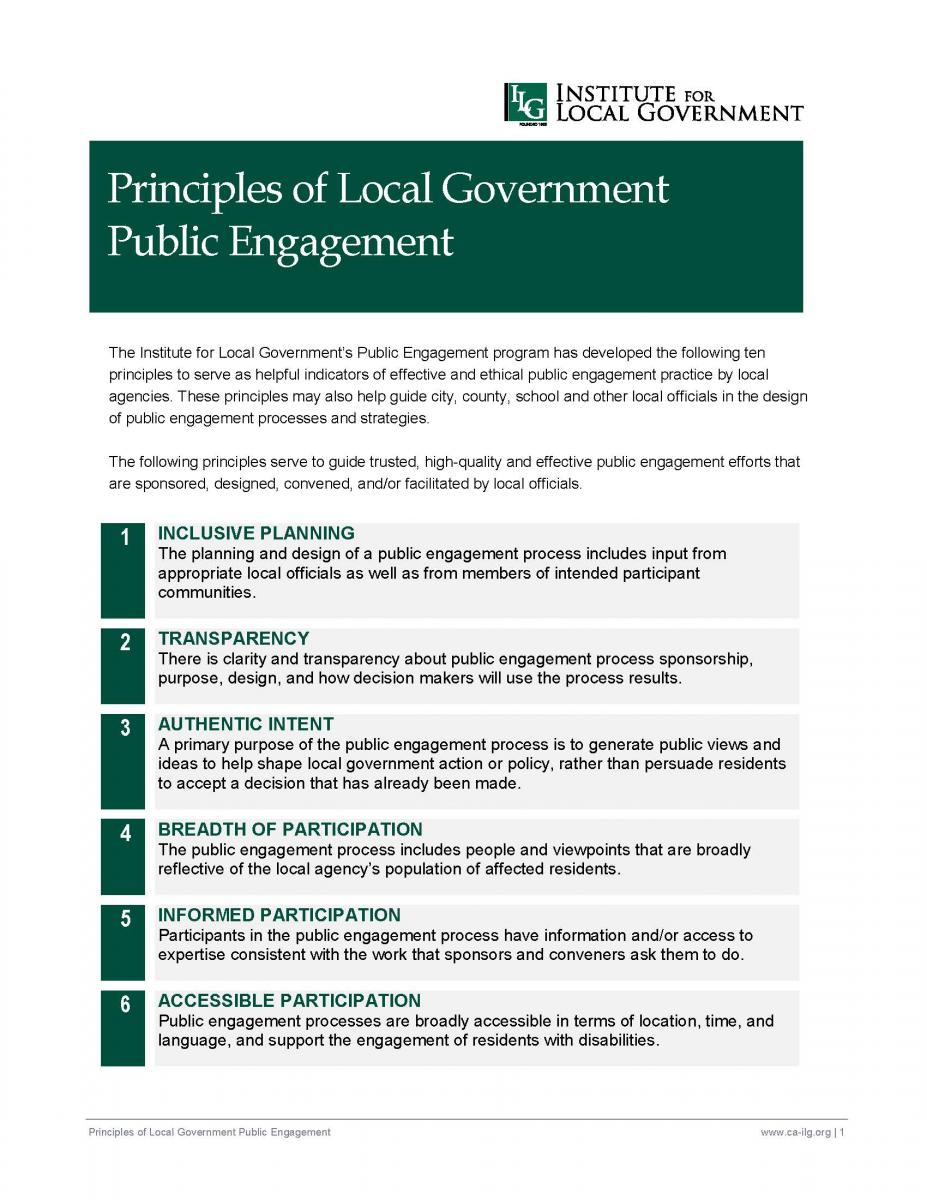
The Institute for Local Government’s Public Engagement and Collaborative Governance program has developed the following ten principles to serve as helpful indicators of effective and ethical public engagement practice by local governments. These principles may also help guide city, county and other local officials in the design of public engagement processes and strategies.

Two leading organizations of public engagement practitioners, the National Coalition for Dialogue and Deliberation (NCDD) and the International Association for Public Participation (IAP2), have each developed principles - or values - to help guide general practice in this field. Find NCCD’s Core Principles for Public Engagement at www.thataway.org/pep and IAP2’s Core Values for the Practice of Public Participation at www.iap2.org.

The Principles of Local Government Public Engagement draws elements directly from both of these documents and includes new language and perspectives especially appropriate to local officials. However a review of the IAP2 and NCCD principles is also recommended.

We hope the following principles will help guide trusted, high-quality and effective public engagement efforts that are sponsored, designed, convened, and/or facilitated by local officials. The Principles of Local Government Public Engagement includes the following ten elements:

  • Inclusive Planning: The planning and design of a public engagement process includes input from appropriate local officials as well as from members of intended participant communities.
  • Transparency: There is clarity and transparency about public engagement process sponsorship, purpose, design, and how decision makers will use the process results.
  • Authentic Intent: A primary purpose of the public engagement process is to generate public views and ideas to help shape local government action or policy, rather than persuade residents to accept a decision that has already been made.
  • Breadth of Participation: The public engagement process includes people and viewpoints that are broadly reflective of the local agency’s population of affected residents.
  • Informed Participation: Participants in the public engagement process have information and/or access to expertise consistent with the work that sponsors and conveners ask them to do.
  • Accessible Participation: Public engagement processes are broadly accessible in terms of location, time, and language, and support the engagement of residents with disabilities.
  • Appropriate Process: The public engagement process utilizes one or more discussion formats that are responsive to the needs of identified participant groups; and encourage full, authentic, effective and equitable participation consistent with process purposes. This may include relationships with existing community forums.
  • Authentic Use of Information Received: The ideas, preferences, and/or recommendations contributed by the public are documented and seriously considered by decision makers.
  • Feedback to Participants: Local officials communicate ultimate decisions back to process participants and the broader public, with a description of how the public input was considered and used.
  • Evaluation: Sponsors and participants evaluate each public engagement process with the collected feedback and learning shared broadly and applied to future engagement efforts.

MORE FROM THE INSTITUTE

Emergency Preparedness in the Neighborhood

Getting the Most Out of Public Hearings

  • Resources
    • Public Service Ethics
      • Leading by Values
        • Responsibility
        • Trustworthiness
        • Respect
        • Fairness
        • Loyalty
        • Compassion
      • Understanding Ethics Laws
        • Personal Gain
        • Perks
        • Transparency
        • Fair Processes
        • Federal Law
        • Consequences
      • Ethics Tools
        • Ethics Assessments
        • Ethics Codes
        • Ethics Commissions
        • Audits
      • Ethics Education (AB 1234 Training)
      • Analyzing Public Service Dilemmas
        • Personal Activities
        • Perk Issues
        • At Meetings
        • Decision-Making Issues
        • Staff Relations and Other Administrative Issues
        • Use of Public Resources
      • Campaigning for Office
    • California Climate Action Network (CCAN)
      • Beacon Award: Local Leadership Toward Solving Climate Change
        • How to Participate in the Beacon Award
        • Who is Participating in the Beacon Award
        • Beacon Award Discussion Forum
      • CCAN Best Practices
        • Greenhouse Gas Inventories
        • Climate Action Plans
        • Energy Efficiency & Conservation
        • Water & Wastewater Systems
          • Water Conservation Leadership Guide: Issues for Local Officials to Consider
        • Green Building
        • Waste Reduction & Recycling
        • Climate-Friendly Purchasing
        • Renewable Energy & Low-Carbon Fuels
          • Greening Agency Fleets
        • Efficient Transportation
        • Land Use & Community Design
        • Open Space & Offsetting Carbon Emissions
        • Promoting Community & Individual Action
        • Adapting to Climate Change
      • Climate Action Examples
        • Bay Area Climate Action Examples
      • Climate Action Resources
        • Bay Area Climate Action Resources
        • Resources - Financial
        • Resources - Information & Data
        • Resources - Tools & Technical Assistance
      • Climate-Related Events & Meetings
        • Bay Area Events
      • Climate Science, Policy & News
      • Climate Action Links & Contacts
      • Online Discussion Forums, ListServes & Blogs
        • CCAN Blog
      • SF Bay Area Climate Portal
        • About this Portal
        • Bay Area Case Stories
        • Bay Area Resources
        • Portal Search Tool
          • Search Tool Feedback Form
    • Public Engagement and Collaborative Governance
      • Public Engagement Basics and Best Practices
      • Engaging the Broader Community
        • Immigrant Engagement & Integration
        • Youth Commissions & Engagement
        • Working with Clergy and Congregations
      • Public Engagement Topic Areas
        • Planning, Housing & Redevelopment
        • Budgeting
        • Public Works
        • Human Services
        • Health and Environment
        • Climate Change
        • Emergency Preparedness
        • SB 375 and Public Engagement
          • Public Participation Plans
        • Day Labor Centers
      • Sustaining Public Engagement
      • Community Leadership, Local Civics, and Citizen Academies
      • Online Engagement, Technology and Social Media
      • Public Engagement Publications & Resources
      • Public Engagement News & Events
    • Intergovernmental Conflict Resolution
      • Getting Help
      • Legal Issues
      • Case Studies
      • Other Resources for Collaboration
    • Healthy Communities
      • Insuring Kids' Health: Online Resource Center
        • What's Right for My Community?
        • Community Stories
        • Frequently Asked Questions
        • Coordinating with Health Plans
        • Templates and Resources
        • Communities Outside of California
        • Online Discussion Forum
      • Healthy Neighborhoods
        • Health, Economic Development and Redevelopment
        • Health and Housing
        • Health and Community Services
        • Health, Planning and Community Design
        • Health and Public Safety
        • Health, Transportation and Mobility
        • Healthy Workplaces
        • News, Events & Blog
    • Land Use and Environment
      • Understanding Planning Basics
        • Housing
        • Housing & Redevelopment Case Stories
          • Case Stories by Region
            • Bay Area
            • Central Coast
            • Central Valley
            • Los Angeles
            • Northern California
            • Orange County
            • San Diego
          • Case Stories by Topic
            • Density
            • Homeless
            • Infill
            • Mixed Use
            • Prefabricated Homes
            • Preserving Existing Housing
            • Redevelopment
            • Second Units
            • Senior
            • Workforce Housing
        • ILG Best Practices
      • Protecting Sensitive Lands
      • Participating Effectively in the Planning Process
      • Land Use & Regional Planning Processes
    • Local Government 101
      • Decision-Making Basics
      • Finance
      • Land Use
      • School Materials
    • Honoring Public Service
      • Retirement Recognition
      • Don Benninghoven Fellowship Program
  • Issue Areas
    • Ballot Measure Activities
      • What's New
      • Resources
    • Day Labor Centers
    • Fiscal Stewardship
    • Housing
    • Leadership Skills
    • Nonprofit Partnerships
      • What's New
      • Resources
      • Community Stories
    • Procurement
    • Property Rights & Takings
    • SB 375 and Regional Planning
    • Technology and Web 2.0
      • What's New
      • Resources
    • Youth Issues
  • Publications
    • Public Engagement/Collaborative Governance
    • Ethics and Public Confidence
    • Fiscal Stewardship
    • Intergovernmental Conflict Resolution
    • Land Use and Environment
    • Local Government 101
    • ILG Logo Items
    • Past (Out of Print) Publications
  • About ILG
    • Programs
    • Mission, Goal, Vision & Values
    • Support the Institute's Work
      • 2010 Symposium Sponsorship
      • Partners
      • Endowment
      • Donate Campaign Funds
    • People
      • Board of Directors
      • Staff
      • Volunteer Opportunities & Internships
    • Our Parent Organizations
    • History
    • Contact
  • Emerging Areas
    • CCAN (emerging areas)
    • Public Engagement and Collaborative Governance (Emerging Areas)
      • California Re-entry Council Network
      • The 2010 Census: Ensuring a Complete Count in California
    • Healthy Communities (Emerging Areas)
More options

See a PDF of the Principles of Local Government Public Engagement at right under "Documents & Resources."

 
© Institute for Local Government   |   RSS Feeds   |   Login