
Post

Assessing Public Engagement Effectiveness: Rapid Review Worksheets
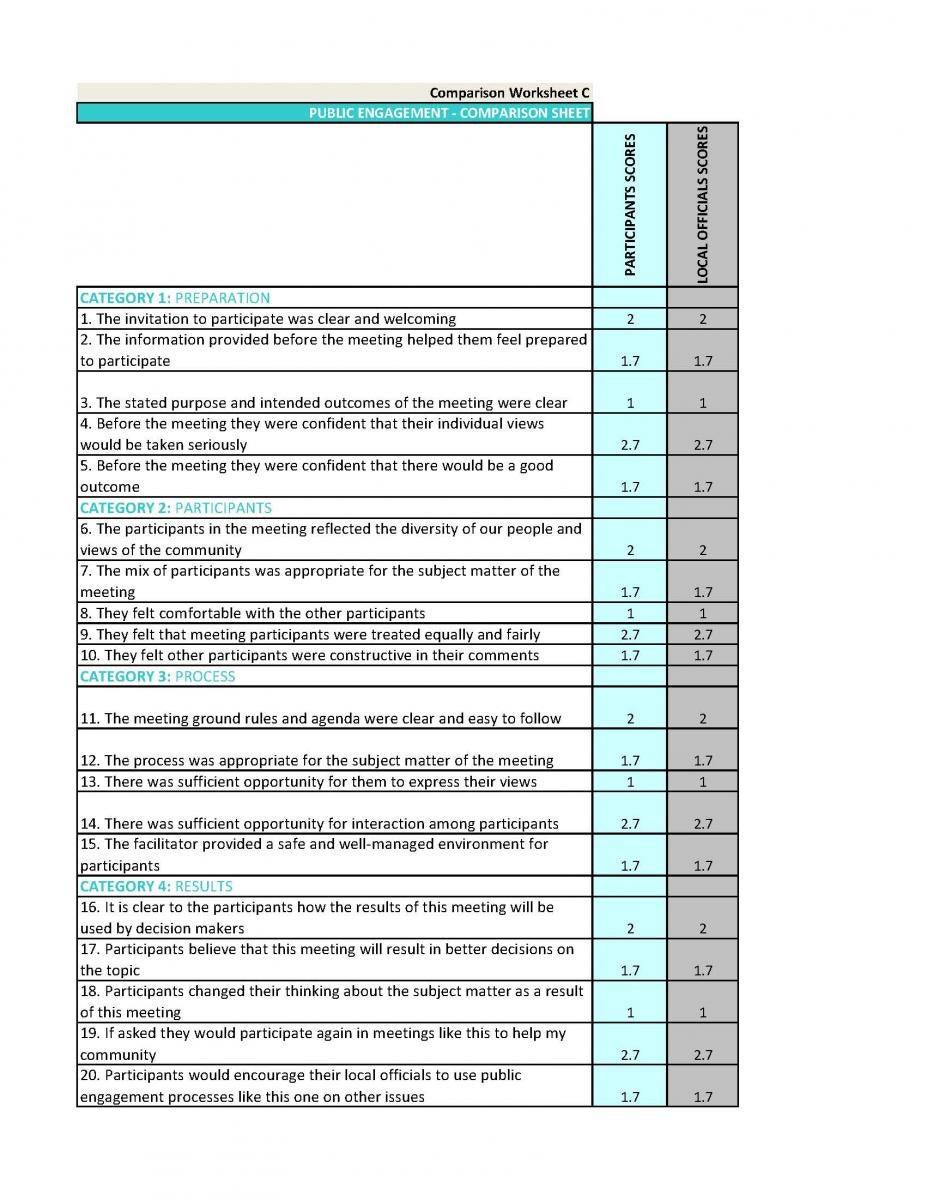
Comparison Worksheet C

Introduction: The Need for Assessing Public Engagement

Image of Assessing Public Engagement Effectiveness: Rapid Review WorksheetsLocal officials are increasingly using a wide range of public engagement strategies to help them inform, consult with and deliberatively engage residents on topics such as land use, budgeting, housing, sustainability, health and environment, public safety and much more.

Typically, cities and counties devote a great deal of time and effort to the planning and delivery of public engagement processes. However, given the press of daily responsibilities, local officials often spend relatively little time assessing how these processes worked for the local agency and the community.

The assessment of local agency-sponsored public engagement is important as it enables local officials and others to gauge participant satisfaction, identify lessons learned, and make refinements and improvements in future efforts. These assessments can be helpful for public engagement efforts that are developed and delivered directly by a local agency as well as when they are managed and facilitated by consultants.

How these Rapid Review Worksheets Can Help

While there is a growing body of literature and experience about how to engage the public, there are few practical tools to gauge the success of these approaches. Recognizing that local officials and staff have limited time and resources, the Institute for Local Government has created these online Rapid Review Worksheets to help local governments assess how well their public engagement processes worked.

Through the use of these Rapid Review Worksheets, a local agency that has sponsored, organized and/or convened a public engagement process or activity can collect information from both participants and relevant local officials. The goal is to gauge the relative success of the process just completed and to guide improvements to future engagement activities.

A Guide to Upfront Process Planning

These Rapid Review Worksheets can also be useful at the public engagement planning stage. An early review of the questions contained in the worksheets can help guide the planning and design of the engagement process as well as ensure that the design and purposes of the engagement process match up with what the agency plans to evaluate.

How to Use the Rapid Review Worksheets

Image of Assessing Public Engagement Effectiveness: Rapid Review WorksheetsWithin the full set of Rapid Review Worksheets, there are four general components (A, B, C, and D) that are available to help local agencies and others assess the success of their public engagement efforts. One or more of these evaluative components may be used depending on the interests and goals of the users.

There is a review worksheet for public engagement participants: Participant Review Instructions and Worksheet (Worksheet A).

There is another worksheet for the relevant sponsoring and responsible local officials: Local Official Sponsors/Conveners Review Instructions and Worksheet (Worksheet B).

Participants and the relevant local officials complete their worksheets to express their respective perceptions of the public engagement process just completed. There are four possible responses to each of the twenty statements in these worksheets: strongly disagree; somewhat disagree; somewhat agree, and strongly agree.

Local government agencies can use only the participant worksheet in order to gauge the satisfaction and feedback of participants; or they may use both the participant worksheet (“A”) and the local official worksheet (“B”) to compare the responses of local officials who have sponsored/organized the public engagement activity to the responses of participants. Both of these worksheets offer the same basic statements and, used together, allow for a useful comparison of perceptions of sponsors and participants. Such a comparison can be instructive in terms of assessing a current public engagement activity and making changing improvements in future public engagement efforts.

Both the participant and the local official worksheet also allow opportunities for those completing the forms to quickly add and total the responses for the four subsections of each worksheet questionnaire. Each subsection focuses on a different aspect of the completed public engagement process: preparation; participants; process; and results. If participants are asked to total their responses to each section, they can get a quick picture of how each section ranked in comparison to the others. This can also be a useful starting point for a facilitated discussion among participants about the public engagement process, if process sponsors wish to (and have time to) make this available.

There are six optional questions on Worksheet A and Worksheet B that follow the twenty basic worksheet statements. They primarily ask the respondent to reflect on his/her responses to the individual questions and to the subsection categories. These may be included or not depending on the interests of process sponsors.

The Participant Review Worksheet can be completed at the end of a public engagement meeting, or can be emailed or mailed later to participants with a request that they be returned. Obviously having participants fill it out before they leave a meeting will help ensure a better response, but this may not always be possible.

Local officials (or others involved in organizing, sponsoring and/or convening the public meetings) will typically fill out the Local Officials Review Worksheet no more than a few days after the public engagement process is complete. While it may be completed individually, it is preferable that the appropriate local officials meet together to collectively determine responses. If the local official worksheet is to be used, it is also preferable that the appropriate local officials complete their worksheets before they see the participant responses.

The third worksheet, the Comparison Worksheet (Worksheet C), is an Excel document that compares, side by side, the aggregated responses of participants and local officials to the same public participation assessment questions. Worksheet C contains a Participants Tally Sheet, a Local Officials Tally Sheet, and a Comparison Sheet. The tally sheets allow easy online computation of the responses from the Participant Worksheet (Worksheet A) and the Local Official Worksheet (Worksheet B). The aggregated responses from both tally sheets are automatically entered on to the Comparison Sheet.

The Comparison Worksheet provides insights into areas where participants and sponsors agree and disagree in their opinions about the completed public engagement process. This can help identify areas for reflection and improvement, and generate useful discussions among local officials about future public engagement processes. Discussion questions for process organizers/sponsors follow the Comparison Worksheet.

The fourth component of the Rapid Review Worksheets is the Process Improvement Worksheet (Worksheet D) that is intended to help local officials (and others if desired) to: a) discuss the responses from both participants and sponsors; b) address specific evaluative questions intended for local officials alone; and c) identify and document improvements. There is a chart that lists all twenty statements and provides space to note possible improvement ideas. This is followed by four “Additional Assessment Questions” that are particularly important for local officials to ask and answer. Finally, there is room to document “Priority Recommendations to Improve Public Engagement” so that ideas for improvements can be explained and memorialized for future reference and use.

Please note that all worksheets are products of the Institute for Local Government (ILG) and may not be altered. 

Overall, this set of Rapid Review Worksheets lays out a four-step public engagement review process. Some local agencies may wish to use one or a number of these assessment steps; others may wish to follow all four. The following chart reviews each worksheet’s purpose.

  Worksheets Description Summary
A. Participant Review Instructions and Worksheet A. A worksheet for public engagement participants to assess their experiences. This worksheet contains 20 statements, with four possible responses for each statement, that allow participants to indicate their perspectives on the public engagement process. As an option, the worksheet also includes a short list of questions that participants can reflect or comment on individually, or be used to guide discussions among participants.
B. Local Official Sponsor/Convener Review Worksheet B. A worksheet for the local agency sponsors/conveners to provide their perspectives on how they believe participants experienced the public engagement process. (The 20 statements and response choices match those on the Participant Worksheet.) There is also a short list of questions that can be considered individually and/or be used to launch a discussion with the other local officials completing the worksheet.
C. Comparison Worksheet C. An Excel document that provides side by side comparisons of the aggregated participant and local officials responses to the statements on Review Worksheets A and B, demonstrating similarities and differences between the views of participants and local agency officials. Two accompanying tally sheets allow easy online computation of these responses. There are also questions to guide initial discussion on these points by local officials.
D. Process Improvement Worksheet D. A worksheet to guide local officials’ discussions of information from Worksheet C, identify areas of improvement, and document these improvements for future public engagement processes. Discussions and recommendations can build on the compared responses of participant and local officials on the Comparison Worksheet © and from the specific additional questions for local official sponsor/conveners found on this worksheet.


Each component builds on the previous one, creating additional insights, documenting what has been learned, and clarifying how improvements can be made in future public engagement activities. However, local officials may choose to use only the Participant Worksheet A, or the Participant Worksheet A and the questions in step two and three of the Process Improvement Worksheet D.


Commands