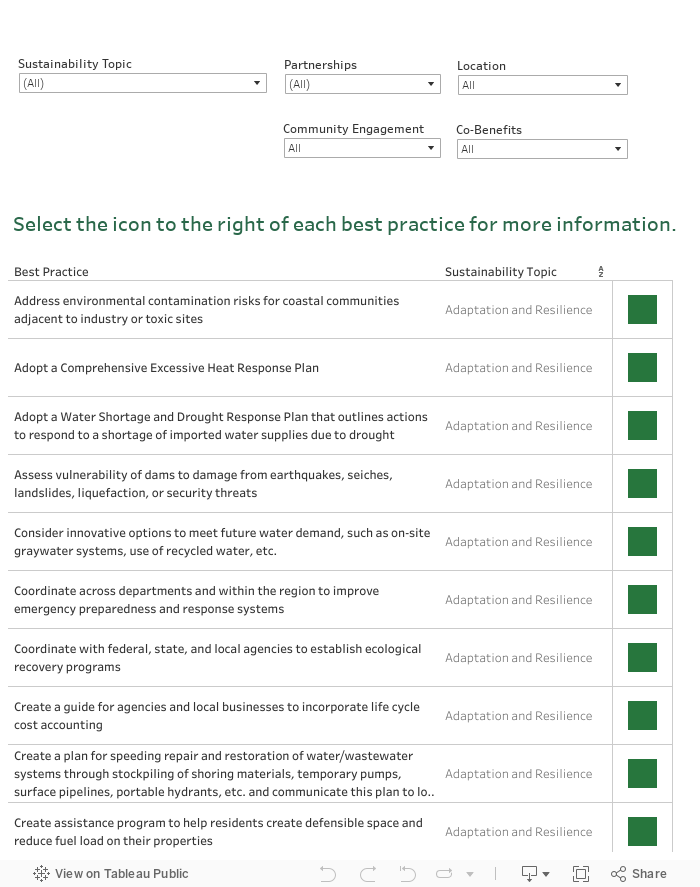
The Climate Change Program’s Best Practices Framework offers suggestions for local action to reduce greenhouse gas emissions in ten Best Practice Areas, both in agency operations and the community at large.
Specific best practice activites can be used to undertake stand-alone programs or can be part of a broad-based climate action plan. Suggestions are designed to reflect the variation among cities and counties and offer a variety of options ranging from simple steps to more complex projects.
Energy generation is the second largest source of greenhouse gas emissions. Thus, strategies to conserve energy and use it more efficiently in agency operations and the community help reduce greenhouse gas emissions. In addition, energy efficiency and conservation measures save money and resources.
Water and waste water system are important elements to addressing climate change for several reasons. First, since energy is used to deliver water and waste water services, using water and wastewater systems more efficiently indirectly also reduces energy use. Second, the impacts of climate change include increased drought and extreme weather events, such as heavy rain and storms, floods and reduced snow pack, all of which effect water availability. Thus, efforts to conserve and use water more efficiently will help cities and counties adapt to the impacts of climate change.
The best practices included in this section apply to cities and counties that provide water and waste water services directly, as well as to those that receive these services from other public or private agencies.
Green buildings reduce energy consumption, use water more efficiently and utilize materials with recycled content, thus saving money and natural resources and related greenhouse gas emissions. Local agencies have taken a variety of approaches to embrace green building policies and programs, consistent with the unique characteristics of their individual communities.
For related information:
See the Green Building Examples section to read about what California cities and counties are doing in this area.
The largest sources of human-generated methane, a potent
greenhouse gas, comes from improperly managed landfills. Thus,
waste reduction and recycling activities reduce the potential to
generate methane at landfills, as well as reducing pollutants
generated from transporting waste to disposal sites. Waste
reduction and recycling activities also conserve natural
resources.
Enhance existing waste reduction and recycling activities at
agency buildings and in the community.
Implement source reduction, recycling and resource recovery
programs for waste organic material. Produce compost, mulch,
energy and fuels from organic waste stream.
Reduce office and commercial waste and increase recycling.
Source reduction, recycling and resource recovery programs
for construction and demolition material.
Decrease carbon footprint of jurisdiction’s waste and
recycling collection system.
Climate-friendly purchasing is the procurement or acquisition of goods and services that are a lesser or reduced source of greenhouse gas emissions when compared with competing goods or services that serve the same purpose.
Energy generated from renewable sources produces less greenhouse
gas emissions than energy generated from conventional sources;
low carbon fuels are those that are formulated to produce fewer
greenhouse gas emissions.
Transportation is the largest generator of greenhouse gas
emissions. Reducing the number and length of vehicle trips and
engine idling reduces those emissions. Efficient transportation
systems also conserve fuel and reduce travel costs and expensive
road repairs.
Well-planned communities with a balance of housing, jobs, shopping, schools and recreation give people the option of walking, biking, or using transit rather than driving. This results in lower greenhouse gas emissions and also promotes physical activity and more vibrant, healthy and sustainable communities.
Forests, parks, agricultural lands and open space serve as “carbon sinks” by storing greenhouse gas emissions that otherwise contribute to climate change.
Providing reliable and objective information helps residents understand the causes, impacts and solutions to climate change. Involving the public in the development of climate change policies and programs builds community awareness and support for local actions that reduce greenhouse gas emissions, including the co-benefits of actions that reduce climate change.
Climate change will impact California in a number of critical
ways, including impacts on agriculture from changing in weather
patterns, water availability, increased severe heat events,
droughts, heavy rains, reduced snow pack, rising sea levels, and
changes in disease patterns. Thus, California cities and counties
need to begin to plan now to adapt to the impacts of climate
change.
Climate action plans are comprehensive roadmaps that outline the
specific activities that an agency will undertake to reduce
greenhouse gas emissions. Climate action plans build upon the
information gathered by greenhouse gas inventories and generally
focus on those activities that can achieve the relatively
greatest emission reductions in the most cost effective manner.
One of the first steps in designing a comprehensive approach to
reducing greenhouse gas emissions is to conduct an inventory that
identifies the origins of your agency’s (or community’s)
greenhouse gas emissions originate. By understanding what
activities generate the greatest amount of greenhouse gas
emissions, it is possible to prioritize subsequent activities to
reduce the emissions in order to achieve the greatest reductions
feasible.